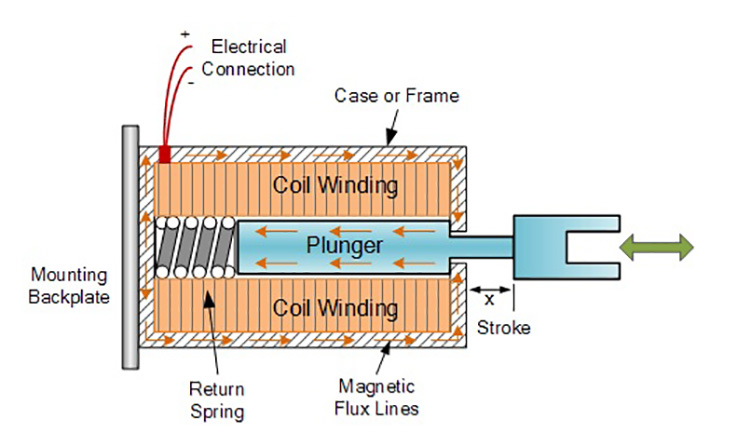
Voice coil linear actuators are widely used in precision motion systems due to their fast response, smooth movement, and high positioning accuracy. Their direct-drive electromagnetic design makes them ideal for applications in automation, robotics, optics, and semiconductor equipment. However, despite their advantages, these actuators also face several operational challenges that engineers must carefully manage.
In high-precision systems, a voice coil linear actuator delivers excellent motion control by converting electrical energy directly into linear force without mechanical transmission elements. While this simplifies the mechanical structure and improves responsiveness, it also introduces engineering challenges related to heat, control complexity, and system integration.
One of the most common challenges in voice coil linear actuator operation is heat generation. Since current flows continuously through the coil to produce force, electrical resistance leads to heat buildup.
Excessive heat can cause:
Reduced force output efficiency
Changes in coil resistance affecting performance
Potential long-term material degradation
Accuracy drift in precision applications
Effective thermal management solutions are essential to maintain stable operation, especially in continuous-duty environments.
Power Consumption and Efficiency Limitations
Although voice coil actuators are efficient in converting electrical energy into motion, they can still consume significant power under high-force conditions. Unlike some mechanical systems that store energy, voice coil systems require continuous current to maintain force.
This can lead to:
Increased energy consumption in long-duration tasks
Higher operational costs in large-scale systems
Limitations in battery-powered applications
Engineers must carefully balance force requirements with energy efficiency to optimize performance.
Control System Complexity
Achieving precise motion with a voice coil linear actuator requires advanced control systems. Because force is directly proportional to current, even small variations can affect positioning accuracy.
Challenges include:
Requirement for high-resolution feedback sensors
Need for fast-response control loops
Sensitivity to load changes and disturbances
Complex tuning of PID or advanced control algorithms
Without proper control integration, system performance can degrade significantly.
Stroke and Force Trade-Offs
Another challenge is the relationship between stroke length and force output. Longer stroke designs often result in reduced force consistency due to magnetic field variations and coil geometry limitations.
This leads to design trade-offs:
High-force systems typically favor shorter strokes
Extended stroke designs may reduce precision at endpoints
Performance may vary across the motion range
Engineers must carefully define application requirements before selecting actuator configurations.
Sensitivity to External Disturbances
Voice coil linear actuators are highly responsive, which also makes them sensitive to external forces and vibrations. While this sensitivity is beneficial for precision control, it can also introduce instability if not properly managed.
Potential issues include:
Positioning errors due to external vibration
Instability in open-loop systems
Reduced accuracy in dynamic environments
Proper mechanical isolation and closed-loop control are often required to mitigate these effects.
Integration Challenges in System Design
Integrating a voice coil linear actuator into a larger system can be complex. Factors such as mounting alignment, sensor placement, and controller compatibility must be carefully considered.
Common integration issues include:
Mechanical misalignment affecting performance
Incompatible feedback systems
Space constraints in compact designs
Calibration requirements for precision operation
Proper system design and testing are essential for optimal results.
Conclusion
While voice coil linear actuators offer exceptional precision, speed, and smooth motion, they also present several operational challenges, including thermal management, control complexity, and system integration issues. Understanding these limitations is essential for engineers to fully leverage their capabilities. With proper design and control strategies, these actuators can deliver highly reliable performance in demanding precision applications.