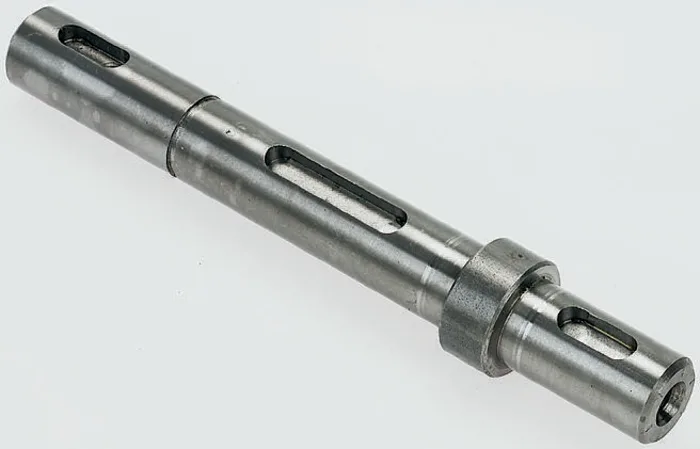

Threaded connections are used throughout mechanical engineering because they provide a practical way to assemble, adjust, and retain components. When threads are incorporated directly into a shaft, they can perform functions that would otherwise require separate fastening hardware or a more complicated connection. This makes threaded shafts useful in equipment where axial positioning, secure attachment, or repeated disassembly is part of normal operation.
A Threaded Shaft is a cylindrical component with external threads formed along part or all of its length. It may act as a fastener, an adjustment element, a support, or part of a power-transmission assembly. Its suitability depends on the thread form, material, loading direction, operating environment, and the way the shaft interacts with surrounding components.
Different Roles of a Threaded Shaft
A threaded shaft does not always rotate or transmit power. In some machines, it remains stationary and supports a moving nut or carriage. In other designs, it rotates to convert rotary movement into linear travel. It may also serve as a mounting stud that secures a component against a shoulder.
Lead screws and power screws are specialized examples of threaded mechanisms. Their threads are designed to convert rotation into controlled axial movement. Ordinary fastening threads, by contrast, are generally intended to create clamping force rather than provide efficient motion conversion. Selecting the correct thread form is therefore essential.
Thread Geometry and Selection
Important thread characteristics include nominal diameter, pitch, profile, lead, tolerance, and engagement length. Metric and inch-based systems are used in different industries. Coarse and fine pitches offer different combinations of assembly speed, adjustment resolution, and resistance to loosening.
The application determines which characteristics matter most. A shaft used for axial adjustment may require a particular lead and backlash control, while a retaining stud needs a thread compatible with its nut and sufficient engagement to develop the required clamping force.
The thread’s transition into the plain shaft section should also be designed carefully. Abrupt changes in diameter can concentrate stress, especially where bending and cyclic loads are present.
Materials and Mechanical Strength
Thread roots are natural stress concentration locations. The material must withstand the tensile, shear, bending, or torsional loads expected in service. Carbon steel is widely used for general-purpose applications, while alloy steels may be selected for higher strength or fatigue demands.
Stainless steel can be appropriate where corrosion resistance is important, but its mechanical properties and galling behavior should be considered. Aluminum and other nonferrous materials may be suitable for lighter-duty or specialized assemblies when the design provides adequate thread strength.
Heat treatment can improve selected properties, although the process must preserve dimensional accuracy. Surface treatments may also be used for corrosion protection or wear control.
Manufacturing and Thread Quality
External threads may be cut on a lathe, rolled using dies or specialized equipment, or produced by other controlled methods. Thread rolling can provide favorable surface characteristics in suitable materials, while cutting offers flexibility for custom geometries and smaller production runs.
The selected process should deliver consistent thread form and pitch. Inspection may include pitch diameter, major diameter, minor diameter, lead accuracy, surface condition, and functional gauging. A shaft may meet its nominal outside diameter yet still fail to assemble if the thread profile is incorrect.
Applications Across Industrial Equipment
Threaded shafts are used in positioning systems, lifting mechanisms, clamps, machine tools, fixtures, adjustment assemblies, and custom machinery. In packaging equipment, they may help position guides or support adjustable components. In industrial fixtures, threaded shafts can provide controlled clamping or height adjustment.
Power screws appear in lifting and linear-motion equipment, but their design must account for efficiency, wear, buckling, and back-driving behavior. Safety-critical lifting applications require appropriately rated components and protective systems rather than relying on a threaded shaft alone.
Installation and Maintenance
Threads should be protected from impact, dirt, and corrosion during storage and assembly. Mating components must use compatible thread specifications. Lubrication may be necessary for moving or heavily loaded threads, but the lubricant must suit the materials and operating environment.
Maintenance inspections should look for damaged crests, wear, corrosion, galling, and signs of loosening. A worn thread can reduce load capacity and make adjustment unreliable. Replacement decisions should consider the complete connection, including the nut or internally threaded part.
Conclusion
Threaded shafts support a broad range of fastening, adjustment, positioning, and motion-conversion functions in mechanical engineering. Their reliability depends on choosing the right thread form, material, engagement, and manufacturing process for the application. When loading, alignment, lubrication, and maintenance are addressed during design, threaded shafts can provide practical and durable solutions for industrial equipment.