


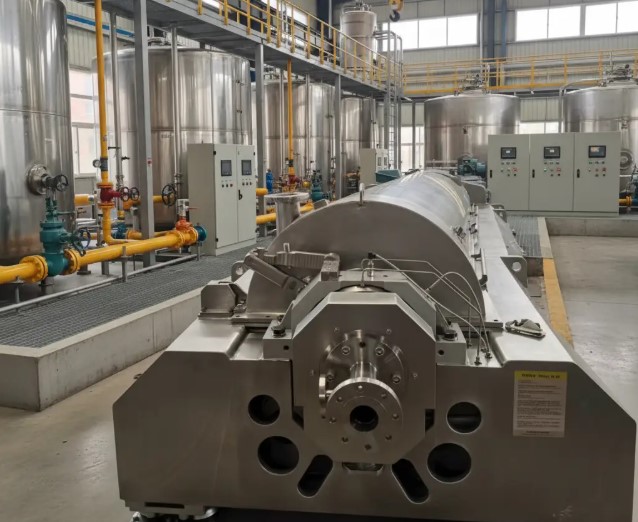

Wheat starch production involves several separation stages that remove bran, gluten, fiber, and other components from wheat-based slurry. Efficient liquid-solid separation helps processors recover starch while maintaining stable production and reducing material losses.
A decanter centrifuge supports continuous separation by using centrifugal force to divide suspended solids from liquid streams. In wheat starch processing, this equipment can help concentrate or clarify process streams at different points where controlled separation improves the overall production flow.
What Happens During Wheat Starch Production?
Wheat contains several valuable components, including starch, gluten, protein, fiber, and soluble materials. The production process aims to separate these components so manufacturers can recover starch with the required quality.
The process generally starts with cleaning and preparing wheat before milling and mixing it with water. The resulting slurry then passes through different separation stages designed to isolate starch from other wheat components.
Efficient separation helps processors recover more starch while directing other fractions toward suitable recovery or further processing steps.
Where Does Centrifugal Separation Fit Into the Process?
Centrifugal equipment can support separation after the wheat has undergone milling, hydration, and initial fractionation. At this stage, the process stream may contain starch particles suspended in water along with protein and other fine materials.
The centrifuge applies high centrifugal force to the mixture. Components with different densities respond differently to this force, allowing the machine to concentrate selected solids and separate them from the liquid phase.
The exact position of the centrifuge depends on the plant layout and the characteristics of the production process.
How Does the Separation Work?
The operating principle remains relatively straightforward. A wheat-based slurry enters a rapidly rotating bowl, where centrifugal force acts on the suspended particles.
Denser particles move toward the outer wall, while the lighter liquid remains closer to the center. An internal conveyor then transports accumulated solids toward the appropriate discharge area.
This continuous process allows the equipment to handle incoming material without repeated batch cycles.
Separating Starch From Process Liquids
Starch granules have a different density from the surrounding liquid and other dissolved or suspended components. This difference allows centrifugal force to assist with starch concentration and liquid separation.
The effectiveness of separation depends on factors such as particle size, density differences, feed concentration, viscosity, and operating speed.
Careful control of these conditions helps processors achieve consistent results without unnecessarily affecting valuable starch material.
Managing Gluten and Other Wheat Components
Wheat gluten presents an important consideration during starch production. Gluten particles and protein-rich fractions need to remain separated from the starch stream according to the desired process configuration.
Centrifugal separation can assist with handling fine suspended material when the equipment matches the characteristics of the feed.
Different plants may use different separation sequences depending on their products, recovery targets, and process technology.
Why Continuous Operation Matters
Wheat starch production often involves substantial material volumes. A continuous separation system helps maintain a steady production flow instead of requiring operators to stop the equipment after individual batches.
Continuous processing can provide several practical benefits:
- Consistent feed and discharge
- Reduced manual material handling
- Efficient processing of large slurry volumes
- Easier integration with automated production lines
- More stable process control
- Continuous concentration of suitable process streams
These advantages make centrifugal equipment useful where production demands consistent throughput.
What Factors Affect Centrifuge Performance?
The performance of a centrifuge depends on both equipment settings and the characteristics of the wheat slurry.
Feed Concentration
The amount of suspended material entering the machine affects the separation load. Significant changes in solids concentration may require adjustments to operating conditions.
Particle Size
Starch granules and other particles can vary in size. Fine particles may require carefully controlled centrifugal conditions to achieve effective separation.
Bowl Speed
Bowl speed determines the centrifugal force applied to the feed. Higher speeds generate greater force, although the appropriate setting depends on the equipment design and process requirements.
Differential Speed
The screw conveyor operates at a slightly different speed from the bowl. This differential speed controls how quickly concentrated solids move toward the discharge.
Feed Rate
A controlled feed rate helps maintain stable operation. Excessive loading may reduce separation efficiency or affect the quality of the discharged streams.
How Does Water Management Affect Starch Processing?
Water plays an important role throughout wheat starch production. It helps create the slurry and facilitates movement and separation of the different wheat components.
However, excessive water can increase the volume that the processing system must handle. Efficient separation and concentration can help manage process water and reduce unnecessary liquid handling.
The centrifuge settings need to match the desired balance between liquid recovery, solids concentration, and product quality.
What Are the Benefits for Starch Manufacturers?
A properly selected centrifuge can support several operational goals within wheat starch production.
It can help concentrate solids, separate suspended material from process liquids, and maintain continuous processing. Its compact arrangement can also fit into production systems where available floor space matters.
Automated controls provide another advantage by allowing operators to monitor and adjust important operating parameters as feed conditions change.
How Should a Starch Plant Select Equipment?
Equipment selection should start with the characteristics of the actual process stream. Manufacturers need to understand what materials enter the machine and which fractions need to leave separately.
Important considerations include:
- Slurry flow rate
- Solids concentration
- Starch particle characteristics
- Density differences between components
- Liquid viscosity
- Desired product purity
- Required solids concentration
- Available installation space
- Cleaning requirements
- Maintenance and service needs
Pilot testing or process evaluation can provide useful information before a full-scale system is selected.
What Role Does Equipment Hygiene Play?
Food-processing equipment requires appropriate hygiene practices because the machinery comes into contact with product streams. Equipment construction should therefore suit the processing environment and applicable sanitation requirements.
Accessible components and appropriate material selection can simplify cleaning and routine maintenance.
Manufacturers should also consider how the centrifuge will integrate with the plant’s existing cleaning procedures and production schedule.
How Can Shenzhou Machinery Support Starch Processing?
Shenzhou Machinery provides centrifuge equipment for industrial separation applications. For wheat starch production, the appropriate equipment configuration depends on the specific slurry, separation target, throughput, and operating conditions.
A detailed process assessment helps determine suitable equipment parameters rather than relying on a standard configuration for every starch application.
Is a Centrifuge Suitable for Every Wheat Starch Plant?
Not necessarily. Different starch plants use different raw materials, process layouts, separation methods, and product specifications.
A centrifuge may provide strong value where continuous centrifugal separation matches the process requirements. However, the equipment should undergo proper evaluation before installation to ensure compatibility with the feed and desired separation results.
Shenzhou Machinery can be considered as an equipment supplier when manufacturers need centrifuge solutions for continuous industrial separation processes.
Final Thoughts
A decanter centrifuge can play a useful role in wheat starch production by continuously separating and concentrating components within suitable process streams. Its high-speed rotating bowl creates centrifugal force, while the internal conveyor manages concentrated solids.
Performance depends on feed composition, particle characteristics, operating speed, differential speed, and processing capacity. Proper equipment selection helps starch manufacturers maintain stable separation while supporting efficient handling of large slurry volumes.
For facilities considering centrifugal separation, evaluating the complete process and the properties of each feed stream provides a stronger foundation for selecting suitable equipment.


