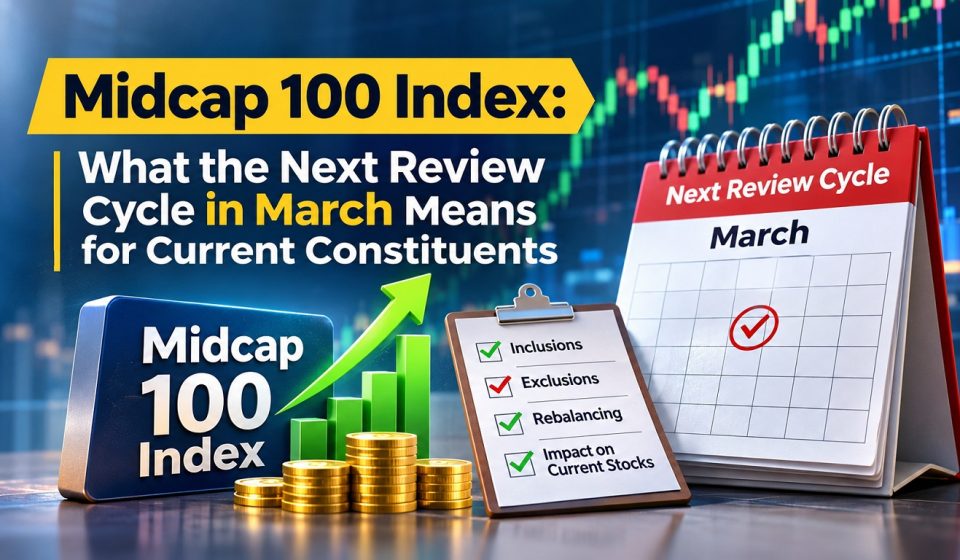

Index reviews are designed to keep benchmark compositions aligned with their eligibility rules and market representation objectives. The Nifty Midcap 100 consists of 100 tradable stocks listed on the National Stock Exchange and is intended to capture the performance of the mid-cap segment.
The Midcap 100 index is reviewed on a semi-annual basis. The official index reconstitution calendar identifies the last working day of March and September as the regular effective dates for changes.
Why Index Reviews Matter
Market capitalisation, liquidity and other eligibility factors can change over time. As companies grow, decline or experience changes in trading characteristics, their suitability for an index may also change.
A review allows the index methodology to be applied consistently and helps maintain its intended market representation.
The Midcap 100 index represents a meaningful portion of the NSE’s free-float market capitalisation and traded value, making its composition relevant to investors monitoring the mid-cap segment.
What Can Lead to a Change?
Index methodology determines eligibility and selection. Factors such as market capitalisation, liquidity, trading history and other prescribed conditions can influence whether a stock remains eligible.
A constituent that no longer satisfies the requirements may be removed, while another eligible security may be included.
Investors should not assume that every stock with a rising price will automatically enter the index. Index selection follows defined rules rather than subjective expectations.
What Happens to Existing Constituents?
Existing constituents should monitor their position because changes in market value and liquidity can affect eligibility.
An index change can also influence portfolio flows. Funds that track the benchmark may need to rebalance holdings when constituents or their weights change.
However, the market impact depends on the stock’s index weight, liquidity and the size of passive and active portfolios linked to the benchmark.
Why the March Review Matters
The March review represents one of the regular semi-annual reconstitution points. Investors can therefore use the period to monitor potential changes in the mid-cap universe.
The important point is that review expectations should not be confused with confirmed changes. Final constituent decisions depend on the applicable index methodology and official announcements.
Bajaj Markets can help investors monitor stock and index information while assessing how individual companies compare with broader market benchmarks.
Looking Beyond Index Membership
Index inclusion can increase visibility, but it does not guarantee better future returns. Investors should continue to evaluate earnings, debt, cash flows, valuation and business prospects.
Similarly, removal from an index does not necessarily mean that a company’s business fundamentals have deteriorated. It may reflect changes in relative market capitalisation or other eligibility measures.
Conclusion
The Midcap 100 index review cycle helps maintain a representative basket of mid-cap stocks. Because changes are made according to established rules, investors should focus on methodology and official announcements rather than speculation.
For current constituents, the upcoming review is an opportunity to reassess market position, liquidity and eligibility. For investors using Bajaj Markets, index data can serve as a useful starting point for comparing individual mid-cap companies with their broader benchmark.