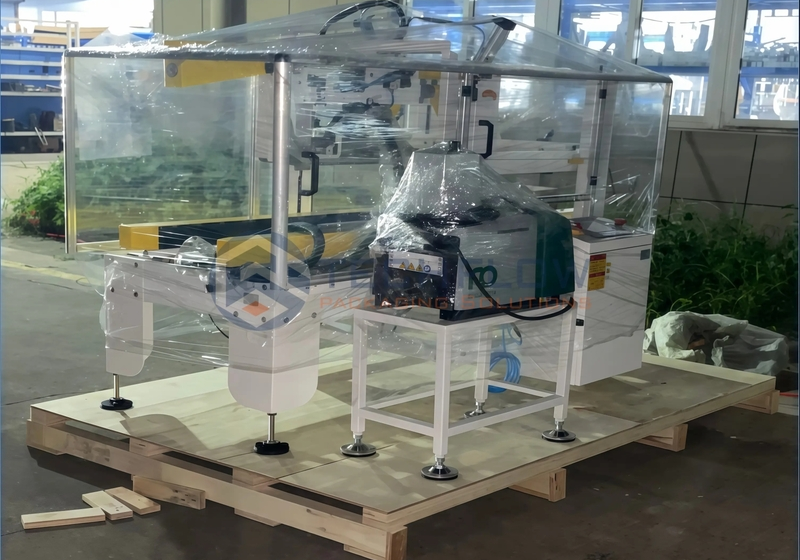

Packaging accuracy and production speed are two important factors that influence the performance of a manufacturing facility. Every carton must be properly formed, securely sealed, and ready to receive products without disrupting the production schedule. When these tasks depend entirely on manual preparation, differences in working speed and folding accuracy can create delays and inconsistent results. Automated carton erection provides manufacturers with a practical way to improve both aspects of their packaging operations.
A Case Erector Machine automates the process of opening flat corrugated carton blanks, folding their bottom flaps, and sealing the base. By controlling these operations through a coordinated mechanical system, the equipment helps produce uniformly formed cartons at a consistent rate. This improves the availability of ready-to-fill boxes and supports smoother movement between packaging stages.
Understanding the Relationship Between Packaging Accuracy and Speed
Packaging accuracy and production speed are closely connected. A carton that is incorrectly opened or poorly sealed may need to be corrected before products can be loaded. These problems can interrupt production, increase material consumption, and create additional work for operators.
Similarly, a packaging process that is accurate but too slow may restrict the output of the entire production line.
Automated case erection addresses both challenges by standardizing carton preparation. The machine follows a defined operating sequence, reducing variations in manual handling while maintaining a predictable carton supply.
1. Consistent Carton Opening Improves Packaging Accuracy
The first important stage of case erection is opening the flat carton blank into its intended box shape.
Manual carton preparation can sometimes produce uneven corners, incorrect panel positioning, or inconsistent dimensions. These variations may affect how cartons move through conveyors and filling equipment.
An automated forming mechanism uses controlled movements to open each blank into the required configuration. Proper alignment helps ensure that the carton maintains its intended shape before the bottom flaps are folded.
Consistent carton opening supports:
- More uniform carton dimensions.
- Better alignment during product loading.
- Reduced carton deformation.
- Smoother movement through packaging equipment.
- Fewer corrections caused by improper box formation.
The quality of the final result also depends on accurate carton scoring, board condition, and suitable machine adjustments.
2. Accurate Flap Folding Creates Stable Carton Bases
After opening, the carton must have its bottom flaps folded into the correct positions. This step is important because the base supports the products placed inside the box.
Incorrect flap alignment can create gaps, uneven surfaces, or weak closure points. Such defects may cause problems during product loading and transportation.
Automated folding mechanisms help position carton flaps consistently. Depending on the machine design, mechanical guides and coordinated movements control how the flaps are folded before sealing.
A properly formed base helps improve carton stability and provides a more reliable foundation for downstream packaging operations.
3. Reliable Sealing Reduces Packaging Defects
Bottom sealing is another important factor in packaging accuracy. Each carton must be closed securely before it moves to the filling station.
Case erectors generally use tape or hot-melt adhesive systems, depending on the equipment configuration and packaging requirements.
A reliable sealing mechanism helps ensure that closure materials are applied in the correct position. This reduces the likelihood of improperly secured carton bottoms and helps maintain consistent packaging quality.
Manufacturers should select a sealing method that matches the corrugated board, required closure strength, and expected transportation conditions.
Regular inspection of tape heads, adhesive application components, and sealing settings is also important for maintaining reliable results.
4. Faster Carton Preparation Supports Higher Production Output
One of the most noticeable benefits of automation is the ability to prepare cartons without requiring employees to assemble every box manually.
In high-volume facilities, manual carton opening and sealing can consume significant working time. This may limit the number of ready-to-fill cartons available to the production line.
An automatic case erector performs several preparation tasks through a coordinated cycle. It can feed blanks, open boxes, fold bottom flaps, and seal carton bases with limited operator involvement.
This can help manufacturers:
- Reduce the time spent on individual carton preparation.
- Maintain a steady supply of empty boxes.
- Reduce delays between packaging stages.
- Improve workflow consistency.
- Allocate employees to other production responsibilities.
The actual output depends on carton size, board characteristics, machine configuration, and operating conditions.
5. Reducing Production Bottlenecks
A packaging line operates efficiently when each stage can handle the output of the preceding process.
If products reach the packing station faster than cartons can be prepared, the line may experience accumulation or interruptions. This can affect production schedules and reduce overall equipment utilization.
A properly selected case erector helps prevent carton preparation from becoming a bottleneck.
For effective operation, manufacturers should match the machine’s output with the requirements of downstream filling, case packing, and sealing equipment. Conveyor speed and carton accumulation capacity should also be considered during system design.
6. Improving Carton Availability Through Automatic Feeding
The carton feeding system has a direct effect on production continuity. It must pick up individual flat blanks and transfer them into the forming section without unnecessary interruptions.
Reliable feeding helps prevent common problems such as missed carton pickups, double feeding, and incorrectly positioned blanks.
Modern machines may use vacuum suction cups, mechanical pickup arrangements, or other feeding technologies depending on their design.
To maintain dependable performance, manufacturers should ensure that carton blanks are properly stacked and meet the machine’s material specifications. Worn pickup components and accumulated cardboard dust should also be addressed through routine maintenance.
7. Supporting Consistent Performance Across Production Shifts
Manual carton preparation can vary depending on employee availability, workload, and working pace. These differences may create fluctuations in packaging output between shifts.
Automated equipment helps standardize the carton preparation cycle. Once the machine is correctly configured, it can perform the same basic sequence repeatedly under suitable operating conditions.
This makes production planning more predictable and helps supervisors manage carton requirements throughout the working day.
However, consistent performance still requires trained operators, proper material replenishment, regular inspections, and timely maintenance.
8. Reducing Material Waste and Rework
Packaging defects can lead to damaged cartons, discarded materials, and additional preparation work.
For example, an incorrectly opened box may need to be removed before filling, while a poorly sealed carton may require correction or replacement.
Automated case erection can reduce some of these problems by controlling carton opening, folding, and sealing operations.
Potential material-related benefits include:
- Fewer cartons rejected because of inconsistent forming.
- Reduced rework associated with manual assembly.
- More consistent use of tape or adhesive.
- Better control over carton handling.
- Less disruption caused by avoidable packaging defects.
These improvements depend on the quality of carton blanks, machine settings, and the effectiveness of quality control procedures.
9. Integrating Case Erection with Automated Packaging Equipment
A case erector can deliver greater operational value when connected to other packaging machines.
A typical arrangement may include the following stages:
- Carton storage: Flat corrugated blanks are organized in a magazine.
- Automatic erection: The machine opens each blank and seals its bottom.
- Product loading: Products are placed into the prepared cartons.
- Case closing: Upper flaps are folded and sealed.
- Inspection: Completed cases are checked for packaging defects.
- Palletizing: Finished cartons are arranged for storage or distribution.
When these operations are properly synchronized, manufacturers can reduce unnecessary handling and maintain a more continuous packaging workflow.
Integration should account for conveyor dimensions, transfer rates, carton sizes, control signals, and available floor space.
Important Features That Influence Accuracy and Speed
When selecting carton erection equipment, manufacturers should examine the features that directly affect forming quality and operating performance.
| Machine feature | Contribution to packaging operations | Automatic blank feeding | Supports consistent carton supply | Accurate forming mechanism | Helps maintain uniform box dimensions | Controlled flap folding | Improves bottom alignment | Reliable sealing system | Provides consistent carton closure | Adjustable carton settings | Supports different packaging formats | Sensors and controls | Help monitor machine operations | Accessible maintenance points | Simplify inspection and servicing | Safety mechanisms | Support safer machine operation |
|---|
These features should be evaluated according to actual production requirements rather than relying on advertised specifications alone.
Maintenance Practices That Protect Machine Performance
Even advanced packaging equipment requires regular care to maintain accuracy and speed. Dust, worn mechanical parts, incorrect settings, and damaged suction cups can affect carton feeding and formation.
A practical maintenance routine should include:
- Cleaning the carton magazine and feeding components.
- Inspecting vacuum cups and pickup mechanisms.
- Checking folding guides and moving parts.
- Verifying sensor alignment and operation.
- Inspecting tape or adhesive application systems.
- Checking belts, chains, and mechanical connections.
- Following recommended lubrication and replacement schedules.
Operators should also monitor carton quality during production. Identifying unusual folds, incomplete seals, or feeding errors early can help prevent repeated defects and unnecessary downtime.
Conclusion
A case erector improves packaging accuracy and production speed by automating the key stages of carton preparation. Consistent carton opening, accurate flap folding, reliable bottom sealing, and automatic blank feeding help manufacturers produce ready-to-fill boxes with less manual intervention.
When properly integrated with downstream packaging equipment, the machine can also support smoother material flow and reduce bottlenecks. Its overall performance depends on selecting the right configuration, using compatible carton materials, and following appropriate maintenance procedures.
For manufacturers seeking more dependable packaging operations, automated case erection offers a practical way to improve carton consistency, support production targets, and maintain an organized packaging workflow.