
Custom Inflatable Interactive Games: Design Options for Different Audiences
Custom inflatable attractions give entertainment businesses, event organizers, schools, resorts, and rental companies an opportunity to create activities that match their audiences and operating needs. Instead of choosing a standard design, buyers can explore different shapes, colors, themes, game mechanics, and branding options to create a more distinctive experience. The right design can make an attraction more appealing while supporting the practical requirements of the venue.
When exploring Inflatable Interactive Games, buyers should consider more than visual appearance. A successful custom design balances audience preferences, gameplay, available space, safety requirements, durability, and budget. A game intended for young children may require a different layout and difficulty level from one designed for corporate team-building events or large public festivals. Understanding these differences helps businesses select customization options that support both customer engagement and long-term usability.
1. Why Customize Inflatable Interactive Games?
Customization allows buyers to adapt an attraction to a particular audience, event theme, business identity, or available installation area. A standard product may meet basic requirements, but a customized version can offer a closer fit for a specific commercial purpose.
Match the Attraction to Your Audience
Different groups have different entertainment preferences. Younger children may enjoy colorful designs and simple activities, while teenagers and adults may prefer sports challenges, accuracy games, and friendly competitions.
A customized attraction can incorporate appropriate colors, graphics, activity layouts, and difficulty levels to reflect the intended audience. However, all design choices should remain consistent with the product’s approved use and safety requirements.
Create a Distinctive Event Experience
Custom designs can help event organizers create an attraction that complements a particular celebration or promotional theme.
For example, a school sports day may benefit from a sports-inspired design, while a family festival may use bright graphics and several simple activity zones. A corporate event might feature branded colors and structured team challenges.
Strengthen Brand Recognition
Businesses that operate entertainment venues or rental services can use approved branding elements to make their attractions recognizable. Logos, brand colors, and selected graphic themes may help create a consistent appearance across event equipment and promotional materials.
Customization should not interfere with safety labels, instructions, visibility, or the attraction’s intended operation.
2. Custom Design Options for Young Children
When designing an inflatable game for young children, the priority should be age-appropriate entertainment, straightforward rules, and a layout that supports suitable supervision.
Colorful Themes and Visual Elements
Bright colors, friendly characters, animals, and imaginative settings can make an attraction more inviting. Depending on the event, themes may include space exploration, underwater adventures, jungle environments, or fantasy-inspired graphics.
Buyers should ensure that any licensed characters or third-party artwork are used with the necessary permissions.
Simple Game Mechanics
Young participants may benefit from activities with clear objectives, such as aiming at large targets or completing simple scoring challenges.
The design should avoid unnecessary complexity. Easy-to-understand rules can help children participate more independently within the supervision arrangements required for the attraction.
Appropriate Layout and Accessibility
The dimensions, entrances, exits, and playing areas should suit the intended age group and the manufacturer’s specifications.
When comparing designs, ask about participant limits, supervision requirements, and any age or size restrictions. Visual appeal should never replace these practical considerations.
3. Design Options for Teenagers and Young Adults
Teenagers and young adults may respond well to activities that combine physical participation with skill, competition, and measurable results.
Sports-Themed Designs
Basketball shooting games, soccer target challenges, and other sports-inspired attractions can appeal to participants who enjoy testing their accuracy and coordination.
Customization may include different target arrangements, themed graphics, team colors, or scoring layouts, provided the changes are approved by the manufacturer.
Competitive Game Formats
Some attractions can be designed around individual rounds, team competitions, or timed challenges. Clear objectives help participants understand how to play and provide event organizers with a practical way to structure activities.
For example, a basketball challenge might use a designated scoring system, while a soccer target game may assign different scores to approved target zones.
Modern Visual Styles
Geometric patterns, bold color combinations, and energetic graphics can suit youth events, campus festivals, and sports promotions.
The overall design should remain easy to understand from a distance, particularly when the attraction will be installed at a crowded public event.
4. Custom Inflatable Games for Corporate Team-Building
Corporate events often require activities that encourage participation, communication, and friendly competition. Custom inflatable games can support these goals when their mechanics are designed around the event’s objectives.
Team-Based Challenges
A custom sports attraction can allow teams to take turns, earn points, or complete a series of challenges. Activities should be straightforward enough for participants with different sporting backgrounds to understand.
Organizers can use a rotation system to give more people an opportunity to participate, subject to the attraction’s capacity and operating requirements.
Company Branding
A corporate design may incorporate the company’s approved logo, brand colors, or event identity. This can create a more coordinated appearance when the attraction is used at employee events, conferences, product launches, or promotional gatherings.
Before approving the artwork, review logo placement, color accuracy, and the visibility of required safety information.
Flexible Activity Layouts
For larger events, a custom design may include more than one activity area or a layout that supports organized group participation. Buyers should confirm whether the proposed configuration is practical for the venue and whether each section can be operated safely.
The final design should account for participant movement, waiting areas, supervision, and the time needed to run each activity.
5. Custom Designs for Schools and Sports Events
Schools, sports clubs, and community organizations may need attractions that support recreational participation and organized activities.
Educational and School Themes
Custom graphics can reflect school colors, mascots, or event themes, subject to the necessary permissions. A school carnival may use playful artwork, while a sports day could feature graphics related to different athletic activities.
The attraction should be selected according to the age range, venue conditions, supervision arrangements, and intended level of physical activity.
Sports-Day Challenges
Basketball, soccer, and target-based games can provide options for short competitions during school events. Different rounds or scoring formats may help organizers structure participation.
Any modifications to targets, equipment, or game mechanics should be approved by the manufacturer rather than improvised after delivery.
Group Participation
For events with many students, consider how the design supports queues, turn-taking, and clear instructions.
The supplier should provide information about capacity, operating restrictions, installation requirements, and supervision. These details help school staff plan the activity alongside the rest of the event schedule.
6. Custom Attractions for Festivals and Public Events
Festivals and public celebrations often require attractions that are visually distinctive, easy to recognize, and suitable for organized visitor flow.
Large Visual Themes
A themed inflatable can act as a focal point within an event area. Depending on the occasion, the design might incorporate sports imagery, seasonal graphics, community themes, or promotional artwork.
Large graphics should remain legible from appropriate viewing distances, and the overall structure must still fit the available site.
Multiple Interactive Activities
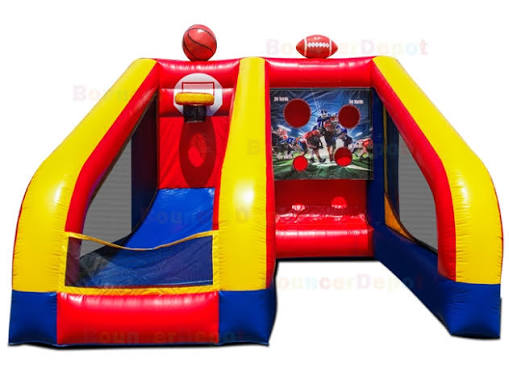
Some custom designs can combine several related activities in one attraction or coordinated installation. For example, a sports-themed setup might include basketball shooting and soccer target challenges.
Combining activities may offer variety, but it can also increase the space, staffing, and supervision needed. Buyers should confirm the exact layout and operating requirements before approving a multi-activity design.
Sponsor and Event Branding
Public events may involve sponsors, organizers, or commercial partners. Custom artwork can sometimes incorporate several approved brand elements while maintaining a coherent appearance.
Clarify logo ownership, artwork approval, production responsibilities, and any restrictions on commercial use before manufacturing begins.
7. Choosing the Right Shape, Size, and Layout
The physical design of a custom inflatable affects its appearance, gameplay, installation, and operating costs.
Compact Designs for Limited Spaces
Smaller attractions may be useful for indoor entertainment centers, shopping centers, private parties, or venues with limited floor space.
A compact design still needs sufficient room for required clearances, anchoring, access routes, blower placement, and participant movement.
Large-Scale Attractions
Large sports games and obstacle-style designs may be suitable for festivals, outdoor recreation areas, and venues that can accommodate substantial installations.
Before ordering, measure the site and confirm ceiling height, access routes, ground conditions, and the complete installation footprint.
Modular or Multi-Activity Layouts
Some buyers may prefer a design that combines several activities or allows different sections to serve different purposes. Ask the manufacturer which configurations are available and whether each proposed activity is supported by the product’s specifications.
Do not assume that individual sections can operate independently or simultaneously unless the manufacturer confirms this.
8. Color, Graphics, and Branding Choices
Visual customization is often one of the most noticeable aspects of a bespoke inflatable.
Select a Consistent Color Scheme
Choose colors that suit the intended audience, event theme, or brand identity. A children’s attraction might use a playful combination of bright colors, while a corporate design may rely on a more restrained palette.
Request a digital design preview or production proof before manufacturing to check that the colors and layout reflect the agreed concept.
Plan Graphic Placement
Graphics can be used to highlight game themes, display targets, identify activity zones, or communicate a brand message.
Ensure that visual elements do not obscure important instructions, interfere with the intended target design, or create confusion about where participants should play.
Confirm Artwork Rights
If the design includes mascots, licensed characters, team logos, or third-party artwork, confirm that the relevant permissions have been obtained.
Using original artwork or properly licensed graphics can reduce the risk of disputes and make it easier to reuse the attraction in future marketing campaigns.
9. Material and Construction Choices for Custom Designs
A visually appealing design must also be practical for the expected operating conditions.
Ask About Material Specifications
Request information about the proposed material, thickness, coating, reinforcement, and suitability for the intended use. Different products may use different construction methods depending on their size and design.
Material selection should consider expected usage frequency, transportation, weather exposure, and maintenance requirements.
Review Seams and High-Stress Areas
Custom shapes and layouts can create different construction requirements. Ask how the manufacturer handles seams, reinforced sections, attachment points, and areas exposed to repeated contact.
The design should be evaluated as a complete product rather than judged by material claims alone.
Confirm Maintenance Requirements
Before production, obtain instructions for cleaning, drying, storage, routine inspections, and repairs.
If the attraction will be used by a rental company, confirm that the proposed design and materials are appropriate for the expected setup frequency and handling practices.
10. Safety Considerations During Customization
Customization should improve the fit and appeal of an attraction without compromising safe operation.
Preserve the Approved Structure
Changes to dimensions, entrances, exits, target placement, or internal layouts can affect how the inflatable is used. Buyers should have the manufacturer evaluate and approve these changes.
Avoid adding unapproved obstacles, attachments, or accessories after delivery.
Confirm Participant Limits
Ask whether the customized design changes any age restrictions, participant limits, operating requirements, or supervision needs.
The final documentation should reflect the actual product supplied, not merely a similar standard model.
Verify Applicable Standards
Determine which safety standards and legal requirements apply to the intended market and installation environment. Request relevant documentation for the customized product and confirm that it covers the actual design.
Do not assume that a standard product’s documentation automatically covers significant modifications.
Plan for Installation and Weather
The design must be suitable for the intended indoor or outdoor setting. Confirm the required anchoring arrangements, clearances, electrical requirements, and weather restrictions.
Provide operators with clear instructions and ensure that staff are trained before the attraction opens.
11. Budgeting for a Custom Inflatable Interactive Game
Custom products may involve additional design and manufacturing costs compared with standard models. A realistic budget should account for the complete project rather than the base product alone.
| Cost factor | What to confirm | Base product | Cost of the selected structure and game format | Custom artwork | Design, graphics, branding, and artwork preparation | Structural changes | Any approved changes to dimensions or layout | Accessories | Blowers, balls, targets, scoring components, and other required items | Shipping | Freight, packaging, delivery, and applicable import charges | Installation | Setup labor, tools, and staff training | Maintenance | Cleaning, inspection, storage, and repair requirements |
|---|
Ask the supplier to identify which features are included in the quotation and which incur additional charges. Confirm minimum order quantities, production lead times, payment terms, and the process for approving design revisions.
For commercial buyers, compare the additional cost of customization with its expected business value. A bespoke attraction may be worthwhile when it supports a clear audience need, brand objective, or recurring event requirement.
12. How to Work With a Manufacturer on a Custom Design
A clear development process can help reduce misunderstandings and prevent costly changes later.
Step 1: Define the Purpose
Explain who will use the attraction, where it will be installed, and what kind of experience it should provide.
Specify whether the primary goal is general recreation, sports competition, corporate team-building, brand promotion, or another activity.
Step 2: Prepare a Design Brief
Provide the preferred dimensions, theme, colors, game format, branding requirements, and expected operating environment.
Include photographs or reference designs when helpful, but clarify which elements are essential and which are open to interpretation.
Step 3: Review the Proposed Layout
Ask for drawings or digital previews showing the structure, targets, entrances, exits, and relevant graphic placements.
Review the design carefully before approving production. Confirm that the layout matches the intended audience and available installation space.
Step 4: Confirm Technical Specifications
Obtain written details covering materials, dimensions, participant limits, required accessories, anchoring, blower requirements, and maintenance.
Ask the supplier to explain any restrictions that could affect your intended use.
Step 5: Approve the Final Design
Confirm the final artwork, product specifications, quotation, delivery schedule, and warranty terms in writing.
Clarify how changes are handled after approval and whether revisions affect the production schedule or cost.
Step 6: Inspect the Delivered Product
Compare the finished attraction with the agreed specifications and documentation. Follow the manufacturer’s installation and inspection procedures before allowing participants to use it.
Conclusion
Custom inflatable interactive games offer businesses and event organizers a flexible way to create attractions for different audiences. Colorful themes and simple activities can appeal to young children, sports challenges can engage teenagers and adults, and branded team games can support corporate events and promotional campaigns.
The most effective design balances visual appeal with practical requirements, including game mechanics, installation space, material quality, safety, and maintenance. Buyers should also establish a clear customization process with the manufacturer, review technical specifications, and confirm all costs before approving production.
By choosing design options that match their audiences and operating goals, entertainment venues, rental companies, schools, and event organizers can create more distinctive experiences while keeping usability and long-term value at the center of the purchasing decision.